Madeleine Halliday online gallery
It is with great sadness that we share the news of Madeleine Halliday’s passing.
Madeleine will be greatly missed by all that knew her.
Madeleine Halliday
29 January 1939 – 25 January 2011
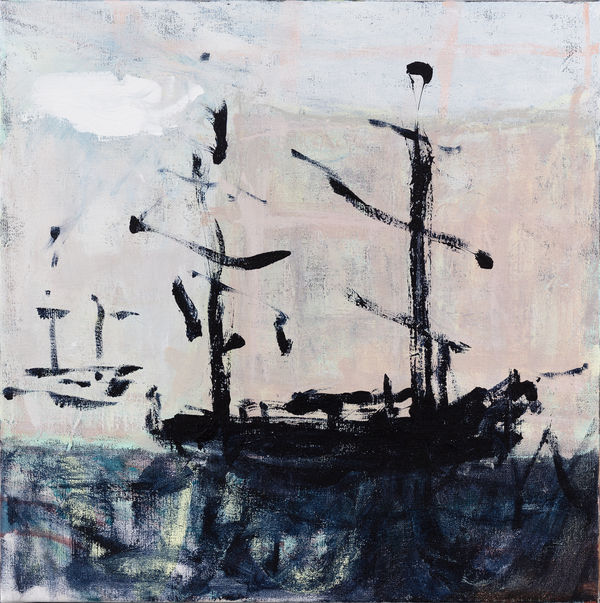
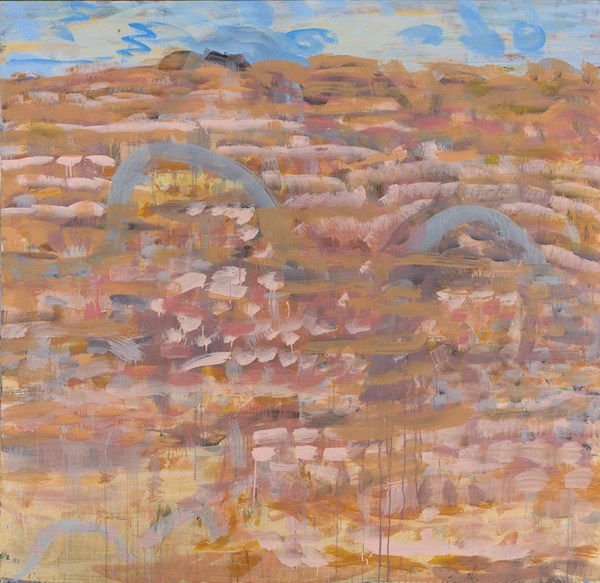
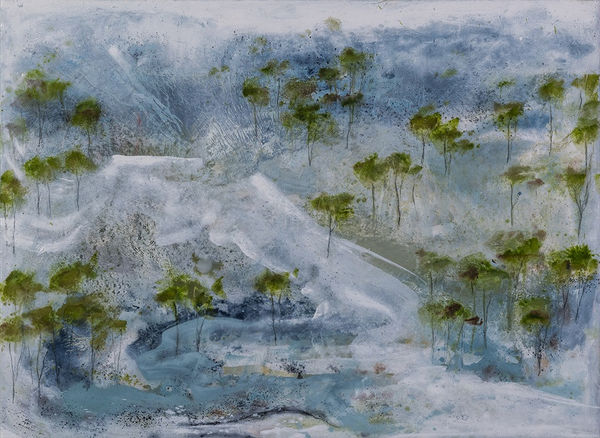
Landscape painting is one of the few areas in which Australians have made an original contribution to world art. We recognise that indigenous art is all ‘country’, but nobody else has ever captured the Australian bush in the manner of Fred Williams, or painted a rainforest like William Robinson. Everybody knows the big names of local landscape painting, but Madeleine Halliday (b.1939) has spent much of her career working in cheerful obscurity. Even though she has been painting continuously since the 1960s Halliday only began exhibiting with the James Harvey Gallery in the 1990s, and with Defiance from 2004. She has been a recalcitrant exhibitor who hesitated to show her work until she had attained artistic maturity. To those who had never previously seen a picture by Halliday her sudden emergence came as a shock. One might complacently assume that such a talented painter has always enjoyed a high degree of visibility, but this is a false assumption. At a time when students are taught the arts of self-promotion as part of their degree we have grown accustomed to the idea that an artist’s sole desire, from day one, is to thrust their work in front of the largest possible audience. Halliday, on the contrary, has always put her painting before her career. Her greatest challenges and achievements have been aesthetic ones. Her most satisfying moments have come from pictures in which everything holds together in ways that can never be adequately explained. She has approached painting as a self-contained activity that can be mastered exclusively through perseverance. There is no magic formula that allows one to paint a successful landscape or draw a convincing portrait. There are no short cuts for attaining the skills of a seasoned campaigner. Confidence and sophistication are the qualities that stand out so forcefully in Halliday’s recent work. To paint the landscape with such freedom and spontaneity an artist has to feel completely at home with her medium. She also requires a certain degree of familiarity with different landscapes, different kinds of light and atmosphere. It takes many years’ experience to be able to create a sense of recessive space with a few flicks of the brush, or to anchor a composition with an adroitly placed line. Many artists yield to the temptation of including too much detail, or leaving flat areas of colour in a way that can be portentous and affected. Halliday has a remarkably sure sense of how much or how little a canvas requires. Her paintings are filled with intricate rhythms and harmonies, brisk notations made with the pencil or the brush. Although every picture may be said to have a dominant tone she includes a huge variety of colours, sometimes in bold swathes, more often as fleeting highlights. As a consequence there are few opportunities for the eye to rest in one of Halliday’s landscapes. Her surfaces are vivid and animated, a series of random incidents that celebrate her own experiences in front of the motif. Nature has been Halliday’s best teacher, but as Cézanne said, the path to Nature leads through the Louvre. In his case that meant a fascination with precursors such as Poussin and Delacroix. With Halliday one feels her particular admiration for Fred Williams, and her close affinities with a range of other Australian landscape painters, from Arthur Streeton to John Olsen, Joe Furlonger, and Elisabeth Cummings. Halliday’s work may be placed within a tradition of modern Australian landscape painting - an extended family of artists each forging their own relationships with scenery that extends from the banks of the Hawkesbury to the red sands of the Outback. Each of these artists has taken something different from these environments, some element that gives their work an individual spark. In Halliday’s case it may be a restless, physical, electric quality that turns this ancient land into an arena that teems with life. There is nothing stately or pastoral about these landscapes. They are imbued with an energy that seems entirely natural but owes an incalculable debt to the personality of the painter. John McDonald September 2010 John McDonald is Art Critic for the Sydney Morning Herald Madeline holds a Diploma of Fine Arts from the East Sydney Technical College, along with a Graduate Diploma of Education from Sydney University. Madeline has worked as a teacher of painting and drawing at a number of respected institutions including The National Art School, Hornsby Technical College, Wollongong Technical College and Kogarah Technical College.
Madeline is recognised for her gestural landscape and seascape works, going on a number of painting trips across the country to get a feel for the land. As she says of her practice ‘Landscape leads me to a world of fabulous contrasts which I try to bring together. Shadow and substance, the fixed and the fluid, the fallen and the upright and the husks and hulls of dead bush, from which new life bursts from all around us. We have to select something from all the chaos out there, sometimes bringing together through memory, the spirit of place and observation’
Madeline has exhibited with Defiance for a number of years, holding solo shows in 2004, 2006 and 2008 and regularly appearing in group shows such as the ‘Same Place, Many Views’ exhibition.